gmsm
GMSM: High-Performance Go ShangMi and Post-Quantum Crypto Library






| English | 简体中文 |
GMSM is a production-ready Go cryptography library focused on ShangMi algorithms (SM2/SM3/SM4/SM9/ZUC) and modern post-quantum primitives (ML-KEM/ML-DSA/SLH-DSA), designed to balance secure defaults, practical APIs, and cross-architecture performance.
Requires Go version: Go 1.25+
Why GMSM
- Broad standards coverage: ShangMi standards, PKCS ecosystem, and NIST PQC (FIPS 203/204/205).
- Practical API design: Interfaces aligned with Go standard library patterns for easier adoption.
- High performance across CPUs: SIMD/assembly optimizations for amd64, arm64, loong64, ppc64le, s390x, riscv64, and more.
- Security with portability: Pure Go fallbacks plus constant-time implementations on sensitive paths.
- Operational confidence: Multi-architecture CI, coverage tracking, and active maintenance.
Quick Start
go get github.com/emmansun/gmsm@latest
package main

import (
  "fmt"

  "github.com/emmansun/gmsm/sm3"
)

func main() {
  sum := sm3.Sum([]byte("hello gmsm"))
  fmt.Printf("SM3: %x\n", sum)
}
Capability Snapshot
- ShangMi: SM2, SM3, SM4, SM9, ZUC
- Post-Quantum: ML-KEM, ML-DSA, SLH-DSA
- PKI and interoperability: smx509, PKCS#7, PKCS#8, CFCA support
- Core building blocks: block modes, padding, DRBG, randomness, ECDH/SM2MQV, and TLS 1.3 hybrid key exchange
User Documentation
- SM2 Elliptic Curve Public Key Cryptography Algorithm Application Guide
- SM3 Cryptographic Hash Algorithm Application Guide
- SM4 Block Cipher Algorithm Application Guide
- SM9 Identity-Based Cryptography Algorithm Application Guide
- ZUC Stream Cipher Algorithm Application Guide
- CFCA Interoperability Guide
- PKCS#7 Application Guide
- PKCS#12 Application Guide
- Deterministic Random Number Generator (DRBG) and Software Random Number Generator Application Guide
- PQC
If you want to raise an issue, we recommend reading How To Ask Questions The Smart Way.
Core Modules
Public Key Cryptography Algorithms
SM2 - Elliptic Curve Public Key Cryptography Algorithm
The core implementation of SM2 elliptic curve public key cryptography algorithm is located in the internal/sm2ec package. This implementation achieves performance comparable to the native NIST P-256 curve implementation in the Go standard library (non-BoringCrypto) and includes assembly optimizations for amd64, arm64, s390x, ppc64le, riscv64, and loong64 architectures.
Features:
- Digital Signature Algorithm (GB/T 32918.2-2016)
- Public Key Encryption Algorithm (GB/T 32918.4-2016)
- Key Exchange Protocol (GB/T 32918.3-2016)
- Key Pair Protection Data Format (GB/T 35276-2017)
For detailed performance optimization analysis and implementation details, please refer to the SM2 Performance Optimization Wiki.
SM9 - Identity-Based Cryptography Algorithm
The underlying mathematical operations (prime fields, extension fields, elliptic curves, and bilinear pairings) of SM9 identity-based cryptography algorithm are implemented in the bn256 package, with optimizations for amd64, arm64, ppc64x, riscv64, and loong64 architectures.
Features:
- Key Generation Algorithm (GM/T 0044-2016)
- Digital Signature Algorithm
- Key Encapsulation Mechanism (KEM)
- Public Key Encryption Algorithm
- Key Exchange Protocol
For implementation details and optimization strategies, please refer to the SM9 Implementation and Optimization Wiki.
Symmetric Cryptography Algorithms
SM3 - Cryptographic Hash Algorithm
SM3 cryptographic hash algorithm (GM/T 0004-2012) implements efficient SIMD optimizations:
Architecture Optimizations:
- amd64: Optimizes message expansion for AVX2+BMI2 and SSE2+SSSE3 instruction sets
- arm64: Uses NEON instructions to optimize message expansion and provides implementation based on A64 extended cryptographic instructions
- s390x/ppc64x: Optimizes message expansion through vector instructions
For detailed implementation analysis, please refer to the SM3 Performance Optimization Wiki.
SM4 - Block Cipher Algorithm
SM4 block cipher algorithm (GM/T 0002-2012) implements multi-architecture assembly optimizations with fused optimizations for common operation modes:
Architecture Optimizations:
- amd64: Uses GFNI, AES-NI instructions combined with AVX2/SSE2+SSSE3
- arm64: Uses AES instructions combined with NEON and provides implementation based on A64 extended cryptographic instructions
- ppc64x: Uses vsbox instructions combined with vector instructions
Operation Mode Optimizations:
- ECB (Electronic Codebook)
- CBC (Cipher Block Chaining)
- GCM (Galois/Counter Mode)
- GCM-SIV (RFC 8452)
- XTS (XEX-based tweaked-codebook mode, supports GB/T 17964-2021 and NIST SP 800-38E)
For detailed implementation analysis, please refer to the SM4 Performance Optimization Wiki.
ZUC - Zu Chongzhi Stream Cipher Algorithm
The Zu Chongzhi stream cipher algorithm (GM/T 0001-2012) implements optimizations based on SIMD, AES instructions, and carry-less multiplication instructions, supporting amd64, arm64, and ppc64x architectures.
Features:
- Confidentiality Algorithm (128-EEA3 / 256-EEA3)
- Integrity Algorithm (128-EIA3 / 256-EIA3)
For detailed implementation analysis, please refer to the Efficient Software Implementations of ZUC Wiki.
Message Authentication Codes
CBCMAC - Block Cipher Based Message Authentication Code
Compliant with the standard “GB/T 15852.1-2020 Information Security Technology - Message Authentication Code Algorithm Part 1: Mechanism using a Block Cipher”, implementing various MAC algorithms:
Supported MAC Modes:
- CBC-MAC (Scheme 1)
- EMAC (Scheme 2)
- ANSI Retail MAC (Scheme 3)
- MAC-DES (Scheme 4)
- CMAC (Scheme 5, RFC 4493)
- LMAC (Scheme 6)
- TR-CBC-MAC (Scheme 7)
- CBCR-MAC (Scheme 8)
Operation Modes and Padding
CIPHER - Block Cipher Operation Modes
Implements various operation modes defined in the standard “GB/T 17964-2021 Information Security Technology - Modes of Operation for Block Ciphers”:
Supported Operation Modes:
- ECB: Electronic Codebook mode
- CCM: Counter with CBC-MAC mode (RFC 3610)
- XTS: XEX-based tweaked-codebook mode (GB/T 17964-2021 / NIST SP 800-38E)
- HCTR: Hash-Counter mode (newly added in GB/T 17964-2021)
- BC: Block Chaining mode (GB/T 17964 legacy mode)
- OFBNLF: Output Feedback mode with Non-Linear Function (GB/T 17964 legacy mode)
Notes:
- XTS mode implements the
cipher.BlockModeinterface and contains internal tweak state, does NOT support concurrent use - BC mode has similar functionality to CBC mode
- OFBNLF mode has limited room for performance optimization from a software implementation perspective
PADDING - Padding Schemes
Implements various standards-compliant padding schemes with constant-time unpadding to defend against Padding Oracle attacks:
| Padding Scheme | Corresponding Standard |
|---|---|
| PKCS#7 | GB/T 17964-2021 Appendix C.2 Padding Method 1 / RFC 5652 |
| ISO/IEC 9797-1 Method 2 | GB/T 17964-2021 Appendix C.3 Padding Method 2 |
| ANSI X.923 | ANSI X9.23 Standard |
| ISO/IEC 9797-1 Method 3 | GB/T 17964-2021 Appendix C.4 Padding Method 3 |
| Zero Padding | Non-standard (legacy compatibility) |
Secure Implementation:
- All schemes provide both
ConstantTimeUnpad()andUnpad()methods - Encrypted data MUST use
ConstantTimeUnpad()to defend against timing attacks Unpad()is only for performance optimization with non-sensitive data
PKI and Certificates
SMX509 - Chinese Commercial Cryptography Certificate Extension
Extended from the Go standard library crypto/x509 package with added support for Chinese commercial cryptography algorithms, compliant with “GM/T 0015-2012 Digital Certificate Format Specification Based on SM2 Cryptographic Algorithm”.
PKCS#7 - Cryptographic Message Syntax
Extended from the mozilla-services/pkcs7 project (archived in February 2024) with added support for Chinese commercial cryptography algorithms, compliant with RFC 2315 standard.
PKCS#8 - Private-Key Information Syntax
Extended from the youmark/pkcs8 project with added support for Chinese commercial cryptography algorithms, compliant with RFC 5208 / RFC 5958 standards.
Key Agreement and Random Numbers
ECDH - Elliptic Curve Diffie-Hellman
Provides an interface design similar to the Go standard library crypto/ecdh, supporting SM2 curve key agreement protocols:
Supported Protocols:
- ECDH Key Agreement
- SM2MQV Key Agreement (recommended)
Features:
- No
big.Intdependency for better performance - Can serve as an alternative implementation to the
sm2package key exchange protocol
DRBG - Deterministic Random Bit Generator
Compliant with “GM/T 0105-2021 Software Random Number Generator Design Guide” and compatible with NIST SP 800-90A partial requirements.
Features:
- Validated with NIST official test vectors
- Does NOT support concurrent use
CFCA Interoperability
CFCA - China Financial Certification Authority Extension
Provides interoperability support with CFCA SADK:
Features:
- SM2 private key and certificate encapsulation (PKCS#12_SM2 format)
- Envelope encryption and digital signature
- CSR generation and parsing
- Private key decryption
Post-Quantum Cryptography
MLKEM - Module-Lattice-Based Key-Encapsulation Mechanism
Compliant with NIST FIPS 203 standard, based on the Go standard library implementation.
Supported Parameter Sets:
- ML-KEM-512
- ML-KEM-768
- ML-KEM-1024
Architecture Optimizations:
- amd64: NTT, inverse NTT, and polynomial multiplication are vectorized using AVX2 instructions
- arm64: NTT, inverse NTT, and polynomial multiplication are vectorized using NEON instructions
- loong64: NTT, inverse NTT, and polynomial multiplication are vectorized using LASX instructions
- ppc64le: NTT, inverse NTT, and polynomial multiplication are vectorized using VSX / VMX (AltiVec) instructions
MLDSA - Module-Lattice-Based Digital Signature
Compliant with NIST FIPS 204 standard.
Architecture Optimizations:
- amd64: NTT, inverse NTT, and polynomial multiplication are vectorized using AVX2 instructions
- arm64: NTT, inverse NTT, and polynomial multiplication are vectorized using NEON instructions
- loong64: NTT, inverse NTT, and polynomial multiplication are vectorized using LASX instructions
SLHDSA - Stateless Hash-Based Digital Signature
Compliant with NIST FIPS 205 standard.
Related Projects
- Trisia/TLCP - A Go language implementation of “GB/T 38636-2020 Information Security Technology - Transport Layer Cryptography Protocol”.
- Trisia/Randomness - A Go language implementation of randomness testing specifications.
- PKCS12 - A fork of SSLMate/go-pkcs12 with commercial cryptography support. Due to the older PKCS12 standard and lower security, it is maintained as a separate project.
- MKSMCERT - A tool for generating SM2 private keys and certificates, mainly for development and testing. It is a fork of FiloSottile/mkcert with commercial cryptography support.
- JavaScript Implementations
- jsrsasign-sm - Extended implementation of jsrsasign that takes full advantage of jsrsasign’s PKIX, CSR, CERT, PKCS8, and other processing capabilities.
- sjcl-sm - Extended implementation of sjcl that leverages its rich symmetric encryption mode implementation, concise code, and good performance.
License
This software is licensed under the MIT License. For details, please refer to the LICENSE file. If you are unfamiliar with the terms of the MIT License, please refer to MIT License. Please be aware of and comply with the licensee obligations!
Acknowledgements
The basic architecture, design, and some code of this project are derived from golang crypto.
The SM4 block cipher algorithm amd64 SIMD AES-NI implementation (SSE part) algorithm is derived from mjosaarinen/sm4ni.
The initial version of SM9/BN256 code was copied from the cloudflare/bn256 project, and later the basic prime field, extension field, elliptic curve operations, etc. were rewritten.
The Zu Chongzhi stream cipher algorithm implementation amd64 SIMD AES-NI, CLMUL implementation algorithm is derived from the Intel(R) Multi-Buffer Crypto for IPsec Library project.
The PKCS7 package code is a fork of the mozilla-services/pkcs7 project (which was archived on February 10, 2024) with commercial cryptography extensions.
The PKCS8 package code is a fork of the youmark/pkcs8 project with commercial cryptography extensions.
Disclaimer
Before using this project, please be sure to carefully read the GMSM Software Disclaimer!
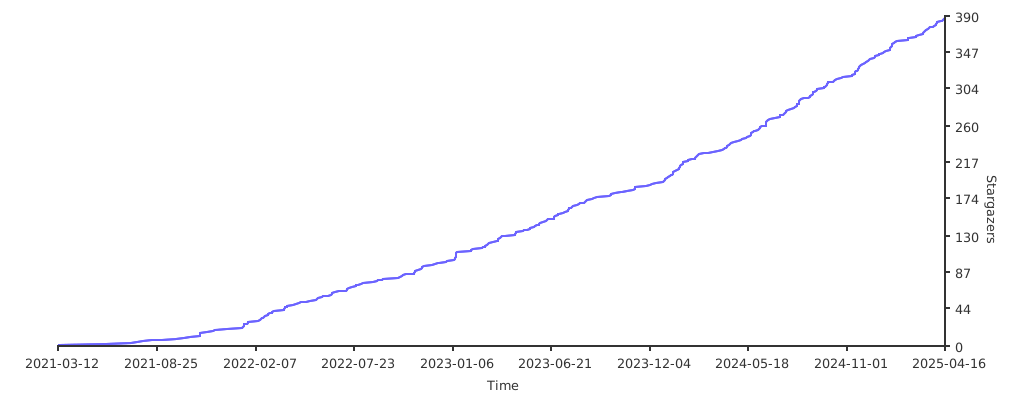
Stargazers Over Time
If this project is useful to you, please consider giving it a Star.